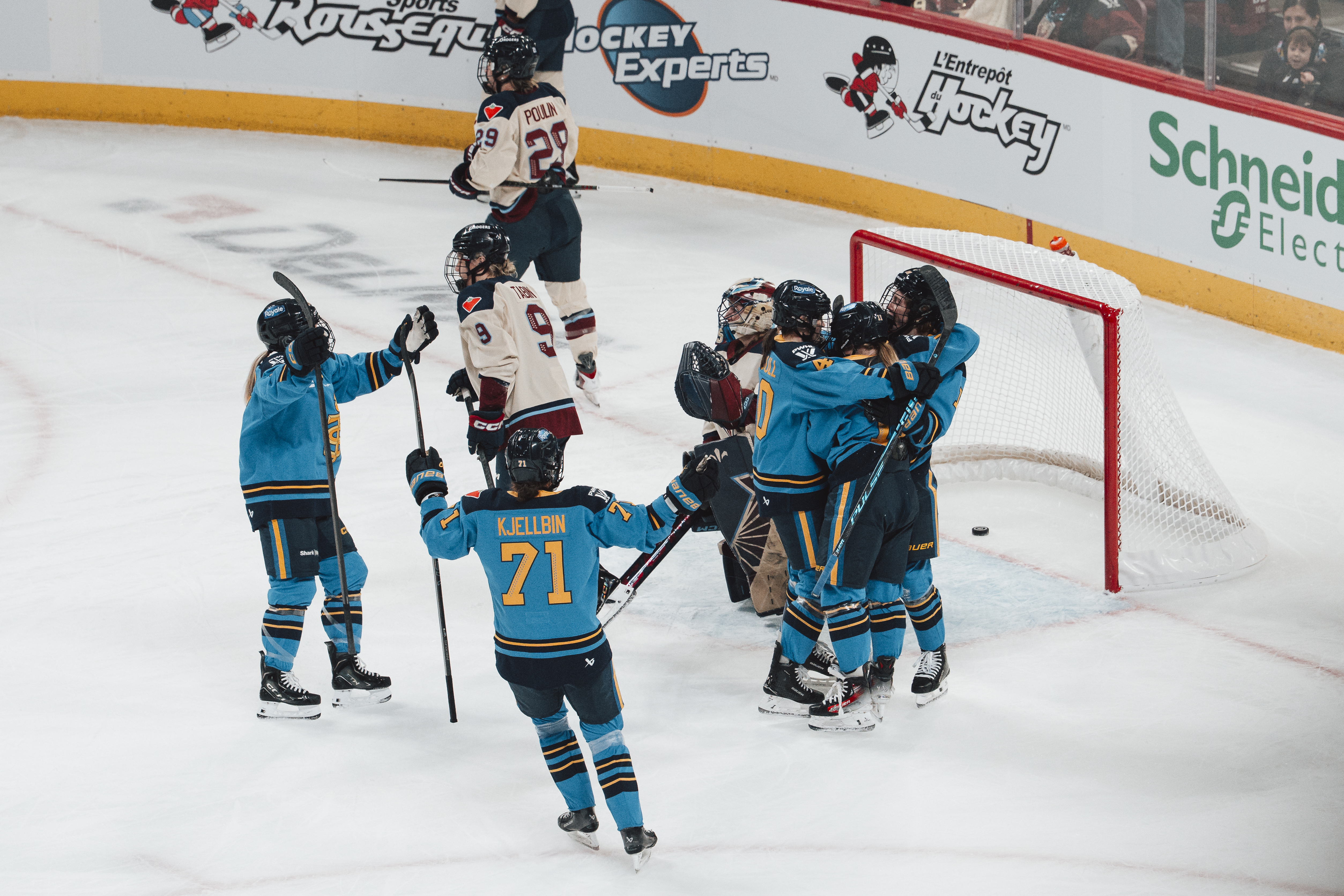
An exhausted Montreal team fell 2–1 to rival Toronto Sceptres after a demanding road trip. Power-play struggles and the impact of travel affected the result, but also offered early-season adversity the team believes will fuel growth moving forward.
For a third year in a row, the Montreal Victoire played in the legendary Bell Centre in front of a crowd of 18,107 fans. However, for the first time, the team faced an intense travel schedule, playing in Halifax, then Vancouver a few days later, followed by Seattle before returning home shortly after the holidays. It was inevitable that all this travel would play a part in the team’s performance.
Adding Toronto to the mix, a fierce rival that had beaten Montreal 2–1 in overtime in the first Bell Centre game, increased the level of ferocity and pressure in this matchup.
Toronto Sceptres forward Jesse Compher opened the scoring in the first period, adding her third goal of the season. What felt like a slow first period was followed by a much livelier second, when Abby Roque brought the Bell Centre to life by equalizing the score.
Physical Play
Despite Montreal equalizing the shots on net during the second period, Daryl Watts netted her third goal of the season for Toronto. A few minutes later, tensions rose between Maggie Flaherty (MTL) and Jesse Compher (TOR), with punches thrown, sending the crowd into a spiral of emotions. Both players were penalized for roughing, a rule whose interpretation remains controversial in the league as officials continue to define the line between physicality and discipline. One of the most physical presences on the team, Abby Roque, shared her thoughts on physicality and where the referees draw the line.
“I do think the reffing has kind of evened out a little more as the season’s gone on,” Roque said. “I think at the beginning of the season, they didn’t honestly really know how to call it … I think you should be allowed to finish checks as long as they’re clean.”
On the other hand, Sceptres head coach Troy Ryan believes the league has done a good job of embracing physicality. “I think the goal, obviously, is to continue to play and go down that road, but just to make sure it’s safe for the athletes,” he said.
Power-Play Struggles
The game ended with a 2–1 score, and a few weaknesses were exposed. Notably, the team continues to struggle with its special teams, now sitting at 2-for-21 on the power play. Too often, the players are unable to fully capitalize on opportunities that could turn the game around. Head coach Kori Cheverie did not shy away from that reality.
“We can afford to shoot more on our power play. That’s for sure,” Cheverie said. “I like the IQ that we are seeing and certainly want to capitalize on the chances that we do have.”
Cheverie also shared the confidence she has in her players on the power play, emphasizing that improvement will come with time.
New Challenges
It was also clear that the team was slower and more fatigued than usual due to the intense travel schedule. With both new teams located on the West Coast, there will be more situations like this throughout the season, making it crucial for the team to adapt to this new lifestyle.
Star forward Laura Stacey shared her perspective on this new challenge, saying that “using the resources around us and learning from it, we’re pro athletes now. We know those teams are going to be there for a while, so it’s important for us to come back and be ready for every game.”
“This is good adversity to be going through right now,” Cheverie added. “Going through it now and finding solutions now, we have to see it as an opportunity to get better,” referring to how last season the team faced too much adversity late in the year, something that disrupted their game and led to their elimination in Game 4 of the first round during last year’s playoff matchup against Ottawa.